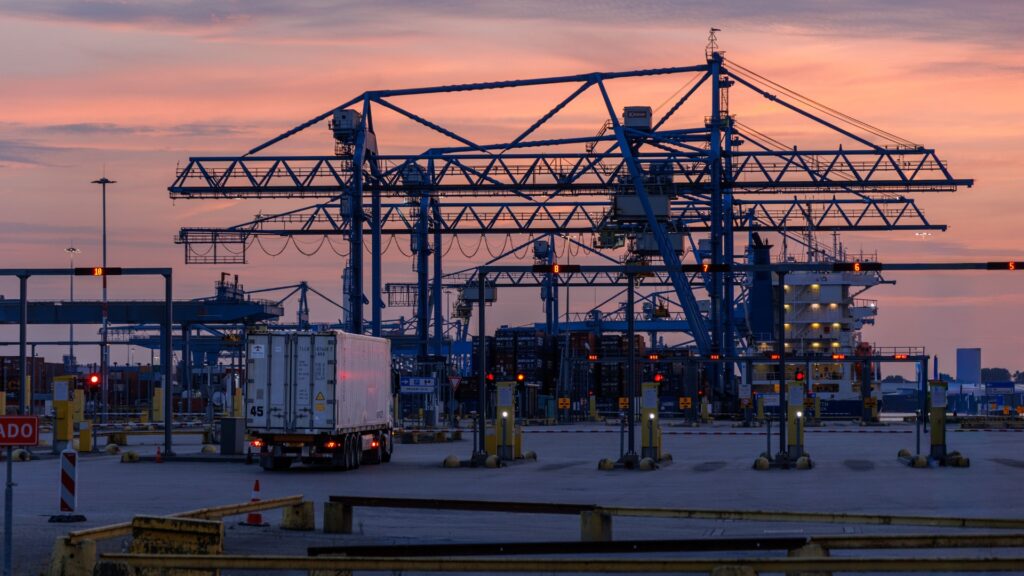
Shipping through the Port of Rotterdam puts your cargo in the largest port in Europe. However, the port is only the first step. What really decides your transit time, your cost and your reliability is what happens after the container is discharged. This guide therefore covers how much Rotterdam handles and which options it opens up. It also explains when another gateway makes more sense. Finally, it follows a container from the quay to a delivery address in Spain or Portugal.
Why ship through the Port of Rotterdam?
Rotterdam is the largest port in Europe and its most connected hinterland gateway. In 2025 the port handled 428.4 million tonnes of cargo and 14.2 million TEU, according to the Port of Rotterdam Authority. It also connects to more than 1,000 ports worldwide. Because the port sits at the mouth of the Rhine and on Europe’s road and rail networks, cargo can move on by truck, train or barge. As a result, a container that lands in Rotterdam reaches almost any European market without a second sea leg.
- Largest port in Europe: 428.4 million tonnes and 14.2 million TEU handled in 2025.
- Around 12,500 hectares of port area, more than 1,000 ports served worldwide and 400+ international rail connections.
- Portex Logistics consolidates freight in Rotterdam and runs fixed lines from the Netherlands and Belgium to Spain and Portugal.
- Road transit from the Netherlands: about 2 to 3 business days to northern Spain, 3 to 4 to southern Spain.
What makes the Port of Rotterdam Europe’s largest gateway?
Rotterdam is Europe’s largest gateway because it combines deep-sea capacity with an unusually dense onward network. As a result, cargo does not stop at the quay. The port lies on the North Sea at the mouth of the Rhine. It also covers roughly 12,500 hectares and stretches for more than 40 kilometres. So it is not simply a place where ships arrive. It is a logistics ecosystem connecting importers, exporters, warehouses and forwarders across Europe.
The port has an extensive network of deep-sea, short-sea, feeder and RoRo services. Together these link Rotterdam with more than 1,000 ports worldwide. For importers, that means routes into Europe from Asia, North America, South America, Africa and the Middle East. For exporters, by contrast, it means direct access to international shipping routes. Cargo therefore does not have to move through another European port first.
Once cargo is on the quay, its location does the rest of the work. From Rotterdam, goods move efficiently towards:
- The Benelux and Germany, within a day by road for most destinations.
- France, Switzerland, Austria and Poland, by road, rail or a combination of both.
- Spain, Portugal and Italy, on fixed road lines or by short-sea and rail services.
For companies using Rotterdam as a European distribution point, the port is only the first step in a longer chain. That is why the logistics partner matters as much as the port.
How much cargo does the Port of Rotterdam handle?
Rotterdam handled 428.4 million tonnes of cargo in 2025, down 1.7% on the previous year. Container throughput, however, grew by 3.1% to 14.2 million TEU. So the mix matters more than the headline number. Rotterdam is a container port, an energy port, a bulk port and a RoRo port at once. That is why so many different supply chains use the same gateway.
| Segment | Throughput in 2025 |
|---|---|
| Total throughput | 428.4 million tonnes (-1.7%) |
| Containers | 14.2 million TEU (+3.1%) |
| RoRo cargo | 25.6 million tonnes (+0.9%) |
| Other breakbulk | 6.1 million tonnes (+4.6%) |
| Dry bulk | Down 6.5% on 2024 |
Please note: figures are the Port of Rotterdam Authority’s annual throughput results for 2025, published in February 2026. RoRo and other breakbulk together make up the breakbulk segment of 31.7 million tonnes.
The port also processes dry and liquid bulk, automotive cargo, food and agricultural products, chemicals and industrial materials. For a forwarder, that diversity is the point. Several transport solutions can be built around one gateway. So when a lane or a terminal comes under pressure, your options stay open.
“Customers often ask us whether Rotterdam is the right port. In practice the port is rarely the problem. What decides whether a shipment arrives on time in Valencia or Porto is the handover. Who clears it, where is it stored, and does it make the departure that week? That is the part we control, and it is why we run fixed lines instead of ad hoc trucks.”
Which transport options does the Port of Rotterdam give you?
Rotterdam gives you four onward modes: road, rail, inland shipping and short-sea. The right one depends on whether speed, cost or emissions matters most. A few pallets may need groupage, for example, while a full trailer may suit FTL. A heavy, steady flow, by contrast, is often better on rail or on the water.
- Road freight, the most flexible option, with door-to-door delivery and the widest choice of shipment sizes. This makes it the default for European distribution from Rotterdam.
- Rail freight, an alternative for suitable cargo flows. Rotterdam is the start and end point for more than 400 international rail connections.
- Combined, rail or barge for the long leg and road for the first and last mile. This is often the best balance for inland destinations.
- Inland shipping, barges moving large volumes along the Rhine into the European hinterland. This also reduces reliance on road transport.
- Short-sea shipping, useful for moving cargo between European coastal markets, including the Iberian Peninsula.
- Why it matters, several modes make it easier to weigh cost, transit time, reliability and emissions against each other.
How does cargo move from Rotterdam to Spain or Portugal, step by step?
Cargo moves from a Rotterdam quay to an Iberian delivery address in five stages. These are terminal release, customs clearance, storage or consolidation, the line haul south, and final delivery. A container arriving in Rotterdam does not automatically reach its final destination efficiently. So this is where an experienced partner earns its place.
- Terminal release, the vessel is discharged and the container is released at the Rotterdam terminal. The demurrage clock starts here.
- Customs clearance, the import declaration is filed so the goods can move freely inside the EU. Portex Logistics arranges customs clearance in Rotterdam as an AEO-certified operator.
- Storage or consolidation, goods are stored, cross-docked or combined with other freight in a Rotterdam warehouse.
- Line haul to Iberia, Portex then loads the shipment on a fixed line to Spain or Portugal. This can be groupage, palletised freight or a full truckload, depending on volume and urgency.
- Final delivery, the shipment is distributed from the local hub to the final address. In Spain, our Spanish operation handles that last leg.
Is the Port of Rotterdam always the best option?
No. Assuming the largest port is automatically the right one is a common and expensive mistake. Rotterdam is the strongest gateway for many supply chains, but not for every shipment. So test the assumption before you route volume through it.
- Port congestion, like any major hub, Rotterdam can experience congestion and delays. In 2025 the port saw pressure from longer vessel dwell times, delays from Asia, weather disruption and strikes. In addition, the Port Authority has acknowledged pressure on terminal capacity.
- Additional handling, if your final destination is far from Rotterdam, the inland leg adds another stage. It also adds another handover and another cost line.
- Documentation and customs, international shipping brings declarations and compliance requirements. Mistakes here translate directly into delays or extra charges.
- Not every shipment needs ocean freight, cargo already inside Europe usually travels better by direct road or rail.
The question is not whether Rotterdam is the best port. It is whether Rotterdam is the best gateway for your supply chain, for this cargo, on this lane.
How does Portex Logistics connect Rotterdam with Spain and Portugal?
Portex Logistics consolidates freight in the Netherlands and Belgium and runs it on fixed lines to Spain and Portugal. So a container that lands in Rotterdam can continue south. You therefore do not have to arrange a separate carrier for each stage. Road transit is currently about 2 to 3 business days to northern Spain and 3 to 4 to southern Spain. Sea freight from Rotterdam, by contrast, takes around 5 to 6 days depending on the service and destination. Portex also covers FTL, groupage and pallet transport, ADR and temperature-controlled freight, sea and rail, warehousing, customs and emergency transport. For the final leg we have our own entity in Spain. We are AEO-certified, a PANCO member and based in Rotterdam. In addition, you are helped by a multilingual team (EN, NL, ES).
Whether you are moving one pallet or a full truckload, the right route starts with your cargo. Global shipping gets it to Europe. The right logistics partner gets it where it needs to go.
Want to read more? See our pages on ocean freight via the Port of Rotterdam and road transport to Spain.
Frequently asked questions
Is Rotterdam the largest port in Europe?
How long does road transport from Rotterdam to Spain take?
Can I ship a single pallet through Rotterdam to Spain or Portugal?
Does the Port of Rotterdam have congestion problems?
Do I need a customs agent for cargo arriving in Rotterdam?