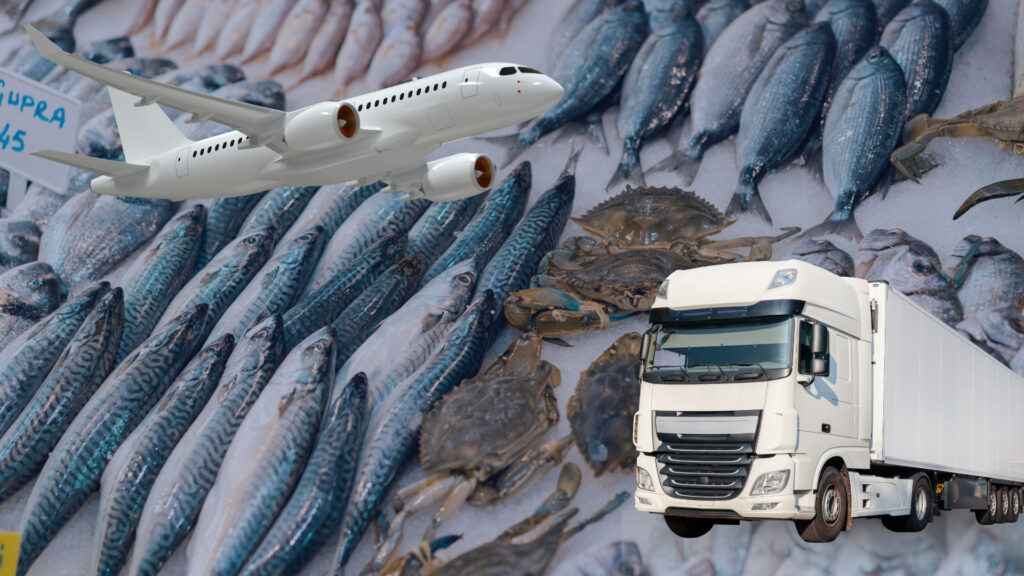
Fish transport in Europe is some of the most time-sensitive freight on the road. From fresh fish landed at a port to frozen seafood moving between warehouses, every shipment needs the right temperature, the right equipment and a plan that holds from collection to delivery. This guide covers what fish transport involves, how fresh and frozen differ, how a shipment moves across Europe, and what to ask a carrier before you book.
How is fish transported across Europe?
Fish is transported across Europe in temperature-controlled trucks, commonly called reefers, which hold the cargo at the temperature the product requires from collection to delivery. Fresh fish moves on the fastest suitable routing because its shelf life is short, while frozen seafood covers longer distances as long as the frozen temperature stays stable. Road freight is the most flexible option on this cargo, because one refrigerated truck can collect at a port, producer or warehouse and deliver to the final address without extra handling, anywhere in the EU road transport network.
- Portex Logistics moves fresh and frozen seafood by road between the Netherlands, Belgium, Spain and Portugal.
- Temperature-controlled transport is available as a full truckload (FTL) and as groupage for smaller volumes.
- The Rotterdam base sits next to Europe’s largest seaport, which keeps the handover from sea to road short.
- Portex is AEO-certified, a PANCO member, and works with a multilingual team (EN, NL, ES).
What is fish transport?
Fish transport is the movement of fresh, chilled or frozen fish and seafood under controlled conditions, so the product keeps its quality and stays safe through the whole supply chain. In practice that means a refrigerated truck, known as reefer transport, which holds a controlled temperature and prevents the fluctuations that damage the cargo.
Seafood rarely travels straight from one address to another. The same pallet can pass through several links before it reaches a plate:
- Port to processing facility
- Producer to wholesaler
- Warehouse to distribution centre
- Food manufacturer to supermarket or restaurant
- Across international borders
- Airport or seaport to the final destination
Because fish is highly perishable, transit time and temperature management decide whether the shipment arrives as sellable product.
Why is temperature control so important when transporting fish?
Temperature control matters because fish loses quality the moment it drifts out of its required range, and unlike dry freight that damage cannot be undone later in the journey. Fresh and frozen fish need different conditions depending on the product, the packaging and the food-safety requirements that apply, and a refrigerated vehicle is what holds those conditions from the first pallet to the last delivery.
A delay of a few hours means far more for perishable cargo than for conventional freight. That is why seafood logistics is planned around the entire chain rather than the driving distance, and why these control points are agreed before the truck is booked.
| Stage of the shipment | What has to be controlled |
|---|---|
| Before loading | Cargo temperature confirmed on the transport order and the vehicle pre-cooled, so the load never starts warm. |
| Loading | Short door-open times, correct stacking, and product already at its temperature when it is handed over. |
| In transit | The set temperature held and monitored across every country on the route. |
| Handover points | Every extra transhipment can let the temperature slip, so handling is kept to a minimum. |
| Delivery and unloading | Delivery window and unloading conditions agreed with the receiver in advance. |
Please note: the temperature your shipment needs depends on the product, the packaging and the food-safety rules that apply to it. Confirm it with your producer or processor and state it on the transport order.
“With seafood, the planning matters more than the truck. Before we load anything we want to know three things: fresh or frozen, what temperature it has to hold, and when it has to be on the ramp. Once those are fixed, the rest is execution. Most of the problems we see on this cargo were built into the booking, not created on the road.”
What is the difference between fresh and frozen fish transport?
Fresh fish is governed by time and frozen fish by stability: fresh product has to reach the receiver as fast as the route allows, while frozen product travels much further as long as the frozen temperature never breaks.
- Time is the constraint, hold the chilled conditions and still deliver as fast as possible.
- A typical chain, fishing port to processing facility to wholesaler to supermarket or restaurant.
- Scheduling decides it, reliable collection slots matter more here than on any other cargo.
- Handling is minimised, every extra stop eats into the shelf life the receiver has left to sell.
- Stability is the constraint, shelf life is longer, but the frozen temperature cannot break.
- Longer distances work, frozen seafood fits into wider European distribution networks.
- It combines well, frozen pallets are easier to plan into groupage loads on a fixed line.
- The risk shifts, the danger is not the clock but a gap in the cold chain at a handover.
Which solution fits depends on the product type, the required temperature, the packaging, the shipment size, the origin and destination, and the delivery deadline.
How does a fish shipment move across Europe, step by step?
A seafood shipment moves in five stages, from confirming the cargo profile to unloading at the receiver. Portex plans the whole sequence in one booking, so the shipper does not have to coordinate each stage separately.
- Confirm the cargo profile, fresh or frozen, the required temperature, the pallets, the weight and the delivery deadline.
- Choose full truckload or groupage, a dedicated vehicle for larger shipments, or a groupage place on a fixed line for smaller volumes.
- Pre-cool and load, the trailer is brought to temperature before collection at the port, producer or warehouse.
- Run the road leg, for example Spain to France to Belgium to the Netherlands, with the temperature held throughout.
- Monitor and deliver, the temperature is watched in transit and the cargo is unloaded in the agreed window.
For larger volumes, FTL gives one shipment its own vehicle and no shared handling. For a few pallets, LTL or groupage puts your cargo on a truck that is already running the route.
What makes fish transportation challenging?
Fish logistics carries risks that do not exist on dry freight, and they compound each other:
- Temperature sensitivity, the cargo has to stay in range the whole journey, with no recovery if it does not.
- Time pressure, fresh seafood has a limited shelf life, so punctuality is part of the product quality.
- Long distances, European seafood chains cross several countries in one movement.
- Loading and unloading, each additional handling point adds delay and temperature risk.
- Road conditions, traffic, driving restrictions and weather all move the delivery time.
- Regulatory requirements, food transport is subject to hygiene, traceability and food-safety rules, and the shipper has to make sure the arrangement meets them.
Spain to the Netherlands shows how these stack up: thousands of kilometres, continuous temperature control, several borders and a fixed delivery window at the end. Collection location, fresh or frozen status, required temperature, FTL or LTL, deadline and documentation all have to line up in one booking.
How do you choose a fish transport company?
Choose on reliability rather than on price alone, because a cheap truck that arrives warm or late costs more than the freight ever saved. Ask a carrier the questions the cargo will raise anyway:
- Can you hold the temperature my product requires?
- Do you have refrigerated transport available on this route?
- Can you handle both full truckloads and groupage shipments?
- How do you monitor the temperature during transit?
- Which European routes do you cover?
- How do you handle delays and unexpected disruptions?
- Can you plan collection and delivery around a tight schedule?
Why choose Portex Logistics for fish transport?
Portex Logistics runs road freight between the Netherlands, Belgium, Spain and Portugal, the lanes most European seafood flows follow. Portex operates from Rotterdam, next to the Port of Rotterdam, so cargo arriving by sea moves onto the road without unnecessary inland detours. For seafood businesses, Portex builds the solution around the cargo, the temperature, the route and the deadline, whether that is one pallet of frozen product or a full refrigerated truckload. Services on these lanes include FTL, LTL and groupage, temperature-controlled transport, ADR transport, European road transport and time-sensitive shipments. We are AEO-certified, a PANCO member, based in Rotterdam, and you are helped by a multilingual team (EN, NL, ES).
Want to read more? See our pages on transport to Spain and shipping to the Netherlands.
Frequently asked questions
How is fresh fish transported?
Can fish be transported by truck across Europe?
What is the difference between fresh and frozen fish transport?
Can I transport a small quantity of fish?
What information do I need to request a fish transport quote?